When we imagine the universe, our minds instinctively place it inside something larger. We picture a gigantic ball containing galaxies, stars and ourselves. That picture immediately creates an uncomfortable question: if the ball has an edge, what lies beyond it?
An infinite universe avoids the edge, but infinity is difficult to visualize and may not describe the actual global geometry of space. There is another possibility: the universe may be finite in volume while having no boundary at all.
This is not a contradiction. A circle has a finite circumference but no endpoint. The surface of a sphere has a finite area but no edge. By extending the same idea one dimension higher, three-dimensional space can, in principle, be finite and unbounded.
Begin with a one-dimensional world
Imagine a species that can exist only on a line. Call them monodimians. They can move forward or backward, but they cannot step sideways or perceive a second dimension. Their entire universe is the line beneath them.
If the line has two ends, their universe has boundaries. But now join those ends to form a circle. The monodimians still experience only one dimension. Locally, their path feels straight. Yet if one travels far enough in a single direction, the journey eventually returns to its starting point. Their universe is finite, but there is no edge anywhere on it.
We can describe the circle from a two-dimensional viewpoint, but the monodimians do not need access to that surrounding plane for their circular universe to exist. The circle has an intrinsic geometry measurable from within: its circumference is finite, and paths eventually close.
Expansion changes what can be observed
There are three useful observational regimes for this circular universe. They are best understood as a conceptual classification rather than a calculation:
Expansion and finite light-travel time prevent signals from the most distant arc from reaching the observer. Part of the global circle exists beyond the observer's horizon.
The point opposite the observer is only just causally visible. Signals arriving from it would be extremely stretched and difficult to distinguish.
If signals have had enough time to travel both ways around the closed space, one source may appear in two directions through paths of unequal length.
Raise the analogy by one dimension
Now imagine two-dimensional beings confined to a surface. If their surface is an infinite plane, they can travel indefinitely. If it is a disk, they eventually encounter an edge. But if their two-dimensional world is the surface of a sphere, it is finite and edgeless.
These bidwellers may initially regard their surroundings as flat because any sufficiently small patch of a large sphere appears flat. Careful measurements over great distances would reveal the curvature. Triangles would not obey ordinary Euclidean expectations: on a positively curved surface, their angles can add to more than 180 degrees.
No point on the sphere's surface is the geometric centre of that surface. Every observer can regard themselves as locally central without occupying a privileged location. The centre we draw inside the sphere belongs to the embedding picture, not to the two-dimensional world itself.
From a sphere to a 3-sphere
Our universe has three spatial dimensions. The analogous closed geometry is therefore not an ordinary sphere but a 3-sphere, often called a hypersphere. An ordinary sphere, or 2-sphere, is a two-dimensional surface. A 3-sphere is a three-dimensional space with positive curvature and finite volume.
It is difficult to visualize because our brains evolved to picture objects inside three-dimensional space, not the curvature of space itself. We can write its geometry mathematically even when we cannot form an honest mental image of it.
This is the three-dimensional volume of the 3-sphere, analogous to the circumference 2πR of a circle and the surface area 4πR² of a sphere.
If cosmic space were exactly a 3-sphere, a sufficiently long geodesic could in principle return to its starting region. There would be no wall, boundary or exterior direction available from within space. Globally, the universe would be closed.
Curvature does not require an external room
Describing three-dimensional space as being wrapped through a fourth spatial dimension is a useful visual analogy, but modern differential geometry gives us a more precise statement: a curved space does not physically require a higher-dimensional container.
Earth's surface can be studied intrinsically by inhabitants who never leave it. In the same way, cosmologists can describe a 3-sphere through distances, angles and geodesics measured inside the space. A fourth spatial dimension is one way to imagine an embedding, not a necessary physical claim.
This also changes how we should speak about a centre. In a homogeneous closed universe, there is no preferred centre within cosmic space. A centre drawn in a four-dimensional embedding diagram is not a destination that a spacecraft could reach by moving through the universe.
The observable universe is not its edge
The farthest region we can see is not the edge of the universe. It is an observational horizon created by the finite age of the cosmos, the travel time of light and the expansion of space.
The often quoted radius of roughly 46 billion light-years is the present-day comoving distance to the most distant matter whose early light can now reach us. It is not the radius of a cosmic ball, and dividing it by π does not determine the curvature radius of a 3-sphere.
The global universe may extend far beyond our observable region. It may be infinite, or finite and much larger than what we can see. Determining its topology requires evidence about spatial curvature and repeated patterns, not simply the distance to our horizon.
Could we see the same galaxy twice?
A multiply connected universe creates one of the most fascinating consequences of this geometry. Light might reach us along more than one path through space, allowing the same astronomical object or region to appear in different directions.
The images would not necessarily match. Different path lengths would show the object at different cosmic ages and from different orientations. In practice, expansion, evolution, obscuration and the enormous possible scale of the topology make such identifications extremely difficult.
Cosmologists have searched for related signatures, including matching circles in the cosmic microwave background. No convincing repeated pattern has yet established a compact cosmic topology, but the search itself is scientifically legitimate.
What current observations suggest
Modern cosmological measurements indicate that the observable universe is very close to spatially flat. "Very close" is not identical to "proven exactly flat." A positively curved universe remains geometrically possible if its curvature radius is substantially larger than the observable region.
There is also a subtle but important point: curvature and topology are related but not identical. A flat universe can still be finite if space has a compact topology, just as a flat sheet can be conceptually joined across opposite edges to form a toroidal topology. Conversely, positive curvature naturally permits a finite closed space, with the 3-sphere as the simplest case.
Geometrically valid
A finite universe need not possess an edge. Lower-dimensional analogies are powerful tools for thinking about global geometry. Multiple light paths could create repeated cosmic images.
Needs care
The observable horizon is not a boundary. Its radius does not yield the curvature radius. A higher-dimensional exterior or reachable centre is not required. An unseen region is not a black hole.
What about the "relative black hole"?
It is tempting to compare regions beyond an observer's horizon with a black hole because light from them may never reach that observer. The analogy is provocative but should not be taken literally.
A black hole horizon arises from strongly curved spacetime around concentrated mass-energy. A cosmological event horizon arises from the large-scale expansion history of the universe. Both limit causal communication, but they are physically different structures and do not share every rule or phenomenon.
The better lesson is broader: horizons are observer-dependent limits on information. They tell us what can influence a particular observer, not necessarily where reality ends.
Further speculative extensions
The dimensional analogy can be pushed further toward concentric closed spaces, irregular global curvature and a centre external to the space we inhabit. These ideas belong together because all three concern the difference between intrinsic geometry and a higher-dimensional visualization.
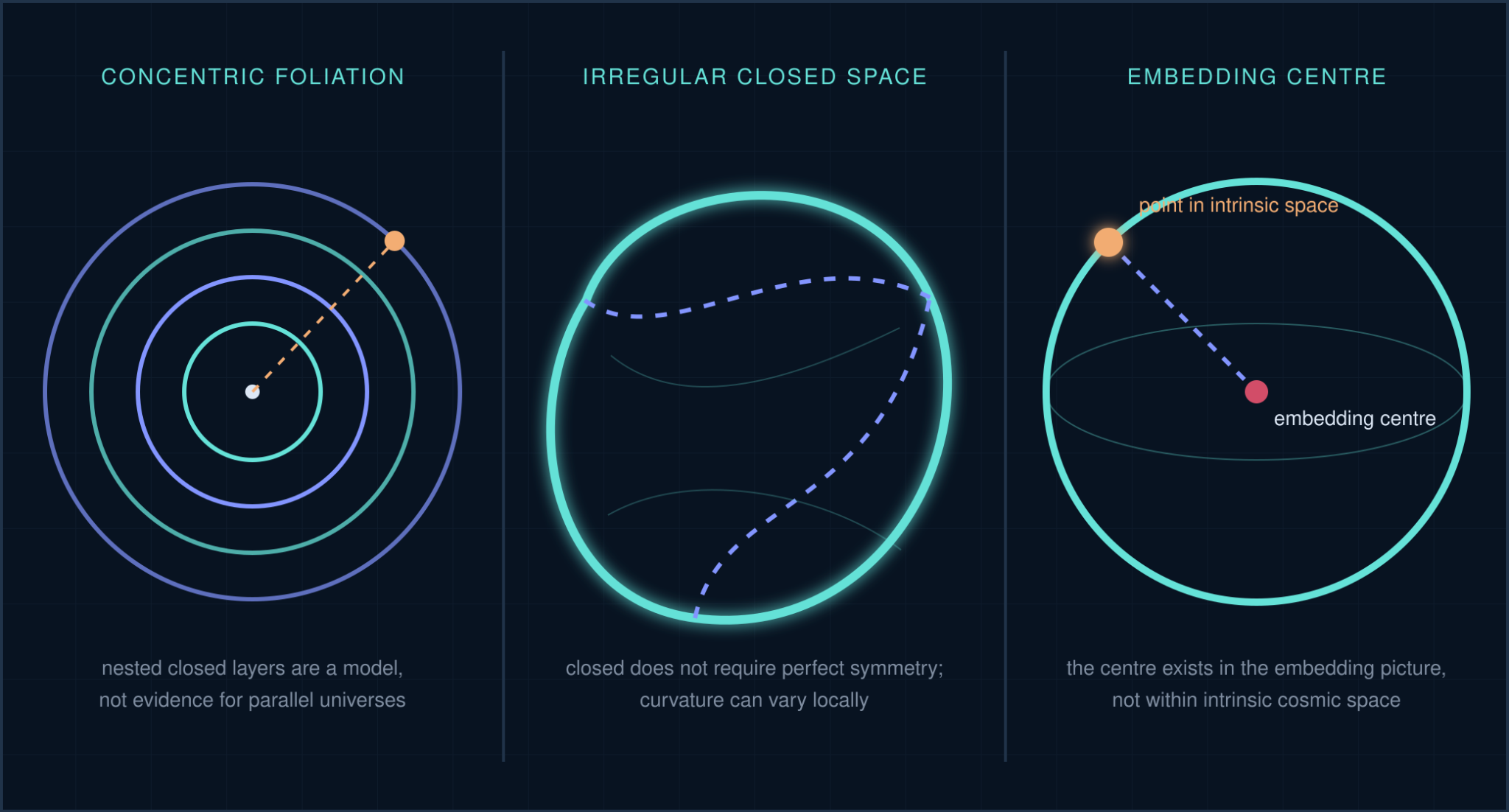
Concentric spaces
Imagine many concentric circles for monodimians, then extend the picture to nested hyperspherical spaces. As a mathematical picture, a family of neighbouring closed surfaces can be described. Calling them parallel universes, or suggesting that motion between them produces gravity, is a speculative leap for which the analogy alone provides no physical mechanism.
Intersecting universes and dimensional gateways
Concentric circles in the same plane never intersect. Their one-dimensional inhabitants remain on separate closed lines and can never meet. But remove perfect concentricity - give the circles different centres, or deform either loop into an irregular closed curve - and intersections become possible.
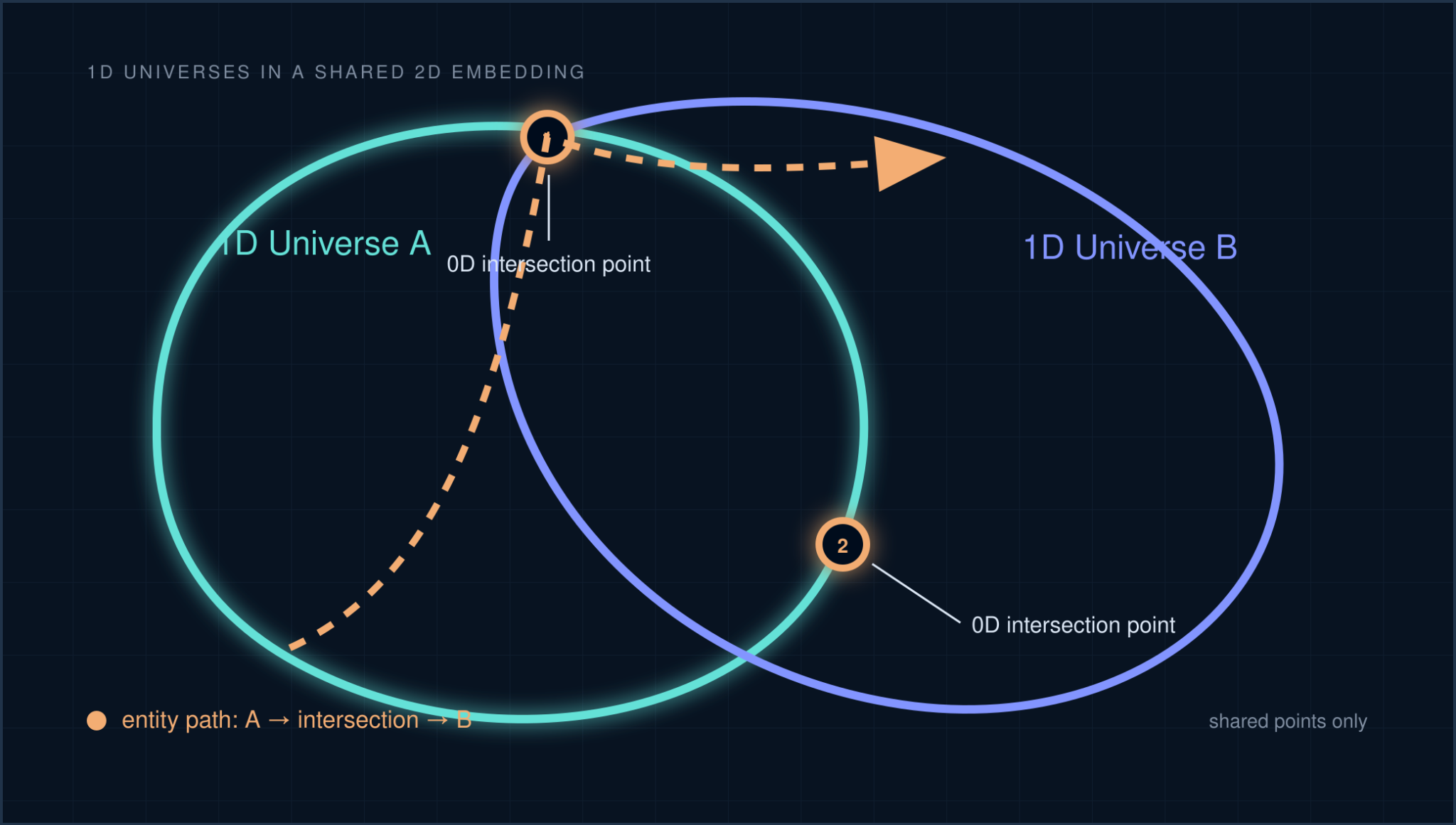
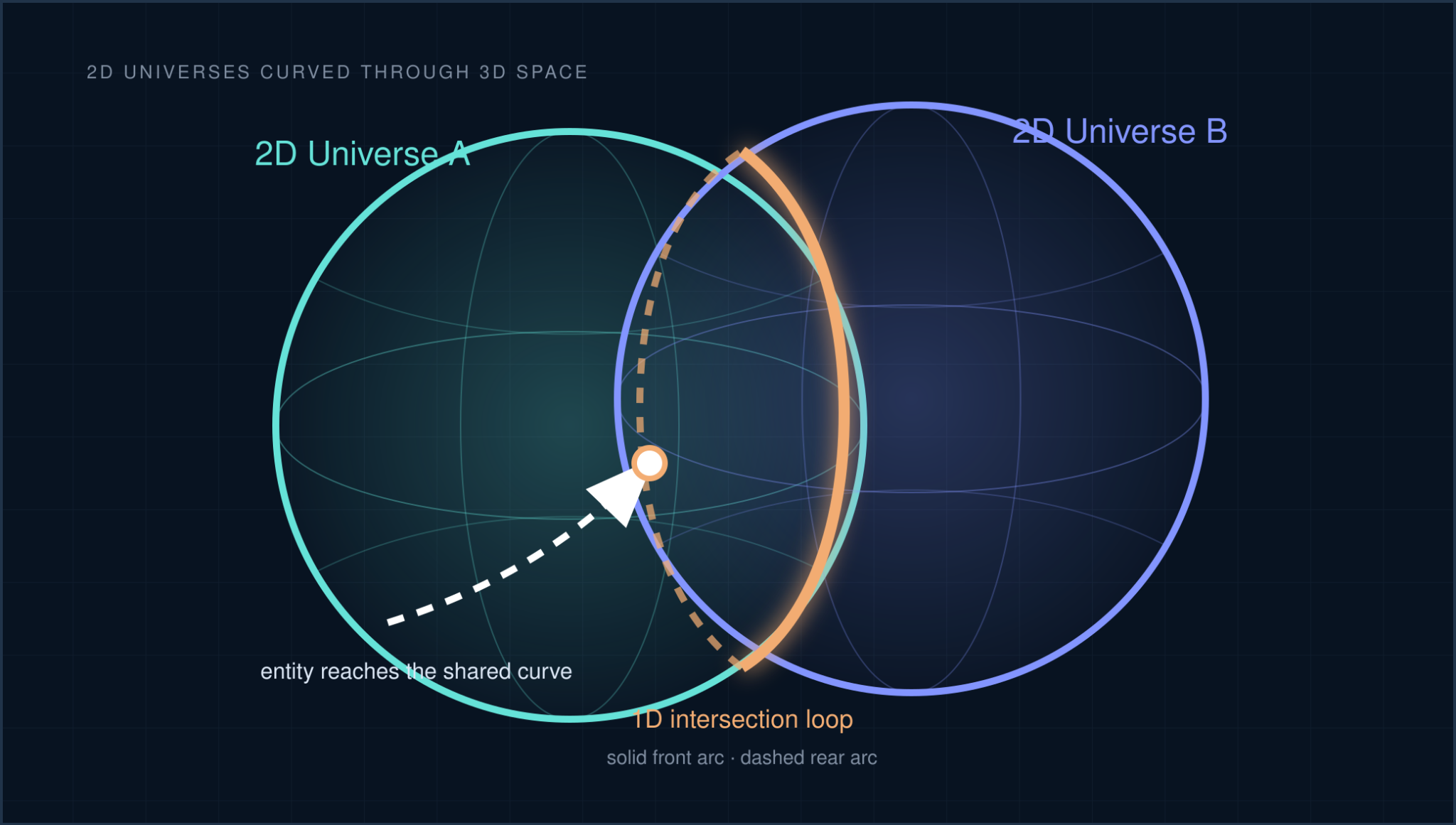
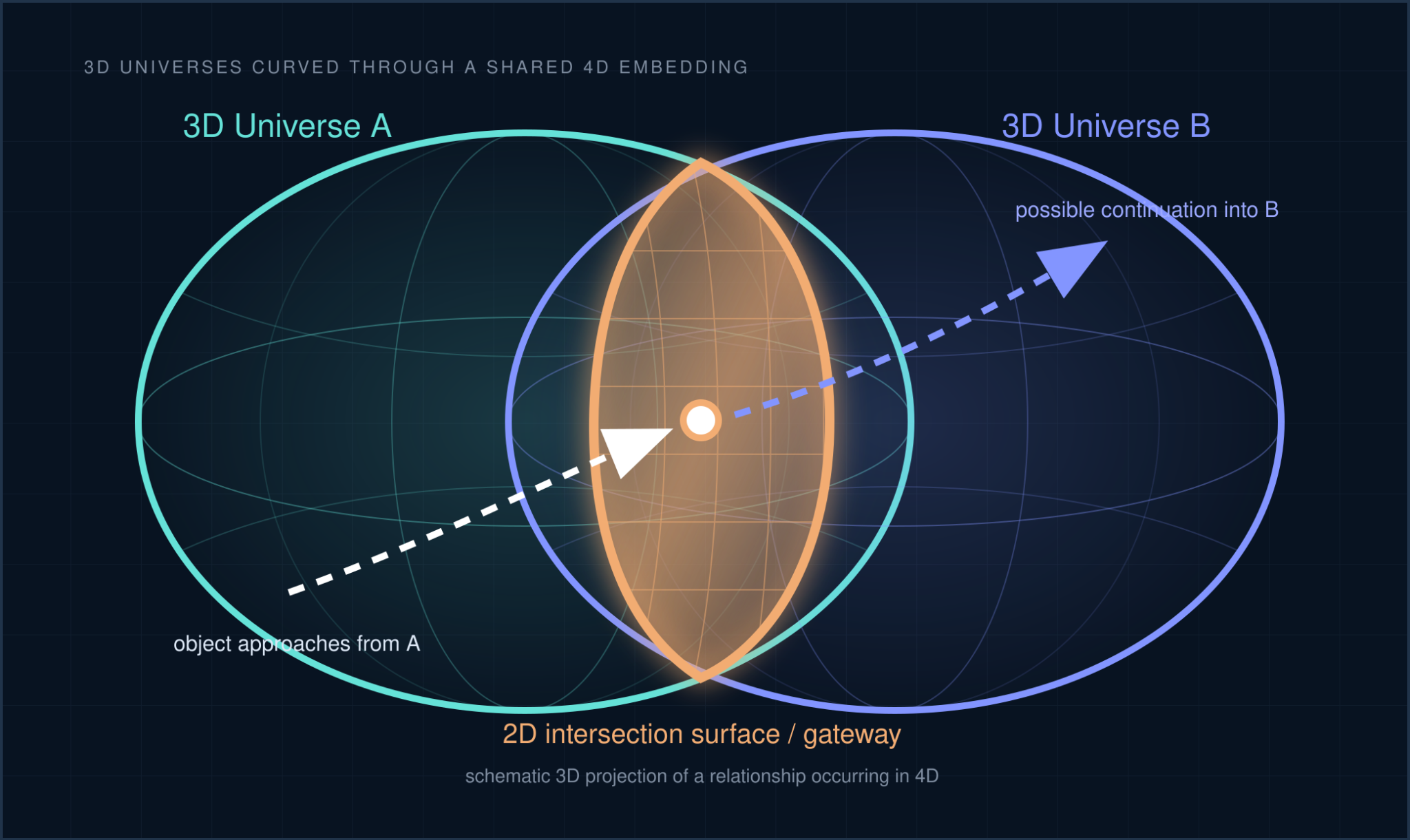
The dimensional pattern is consistent. Two one-dimensional universes embedded in a common two-dimensional plane can intersect at zero-dimensional points. Two two-dimensional universes embedded in three dimensions can intersect along one-dimensional curves. Two three-dimensional universes embedded in four dimensions can intersect along two-dimensional surfaces.
when two n-dimensional hypersurfaces share the same (n + 1)-dimensional embedding space and meet transversely
For the one-dimensional case, an entity travelling along Loop A reaches an intersection point that also belongs to Loop B. If the two universes are physically coupled at that point, the entity may continue along A or switch onto B. To inhabitants of A, it disappears at the crossing. To inhabitants of B, it appears there. Nothing is created or destroyed in the embedding plane; the entity changes which universe carries its path.
The same logic extends upward. A bidweller on a two-dimensional universe could switch surfaces along their common one-dimensional intersection loop. In our three-dimensional case, the gateway would not be a point or a line. It would be a two-dimensional surface embedded within our space. An object contacting that surface might pass from one three-dimensional universe to the other and consequently disappear from one while appearing in the other.
Could these intersection surfaces appear as black holes, white holes or wormholes?
Within this hypothesis, yes: these intersection surfaces are gateways by construction. They are locations shared by two otherwise separate three-dimensional universes. If matter, radiation or information can follow the geometry from one universe into the other, then the shared surface is precisely where that transfer must occur.
What remains uncertain is how such a gateway would appear to observers and whether any known astronomical object is an example of one. Its observed behaviour could depend on the direction and conditions of transfer.
If matter and light can leave our universe through the intersection but cannot return along the same path, the surface may appear as a one-way sink bounded by a horizon.
If matter and energy can enter our universe through the intersection but cannot travel back, the surface may appear as a source from which objects emerge without an observable origin in our universe.
If passage is possible in both directions, the intersection functions as a traversable connection between the two universes.
The important distinction is between the gateway itself and its observable behaviour. The geometric model predicts a shared two-dimensional surface. Black-hole-like, white-hole-like or wormhole-like behaviour would be different physical states of that gateway, determined by the surrounding spacetime metric, causal structure and direction in which matter and information are permitted to travel.
So the proposal is deliberately stronger than saying that these surfaces merely might be gateways. In this intersecting-universe model, they are gateways. The open question is whether general relativity, a higher-dimensional theory or quantum gravity can produce a stable intersection with the necessary transfer rules, horizons and conservation of energy-momentum - and whether the black holes, hypothetical white holes or possible wormholes we discuss in physics are manifestations of such intersections.
Irregular curvature
A closed space need not be drawn as a perfectly symmetric circle or sphere. Curvature may vary from place to place. In general relativity, matter and energy do produce local spacetime curvature, but that established fact does not imply that every irregularity in a hand-drawn embedding represents a new force or cosmological structure.
The centre is outside
Every point on a regular circle is equally distant from a centre that lies outside the one-dimensional universe. The same is true for a sphere drawn in three dimensions. For a 3-sphere embedded in four-dimensional Euclidean space, an analogous centre can be defined in the embedding space.
However, that centre is not part of the intrinsic universe and is not physically required by the geometry. Modern cosmology therefore says that a homogeneous 3-sphere has no privileged centre within the universe; whether any higher-dimensional embedding has physical reality is a separate hypothesis.
Why the thought experiment still matters
The strongest part of this idea is not the claim that our universe must be a hypersphere. It is the challenge to ordinary intuition. Human senses evolved for short distances and low speeds on an apparently flat landscape. Cosmic geometry is under no obligation to resemble the containers, surfaces and edges of everyday life.
A finite, edgeless universe is mathematically coherent. Whether our universe has that geometry is an observational question. The distinction between those statements is where speculation becomes science.
“Perhaps the finite universe has no edge because an edge was never part of its geometry.”
The dimensional ladder remains compelling: a line can close into a circle, a surface can close into a sphere, and three-dimensional space can close into a form we can calculate but cannot truly see from the outside. The idea is a reminder that the limits of imagination are not necessarily the limits of nature.