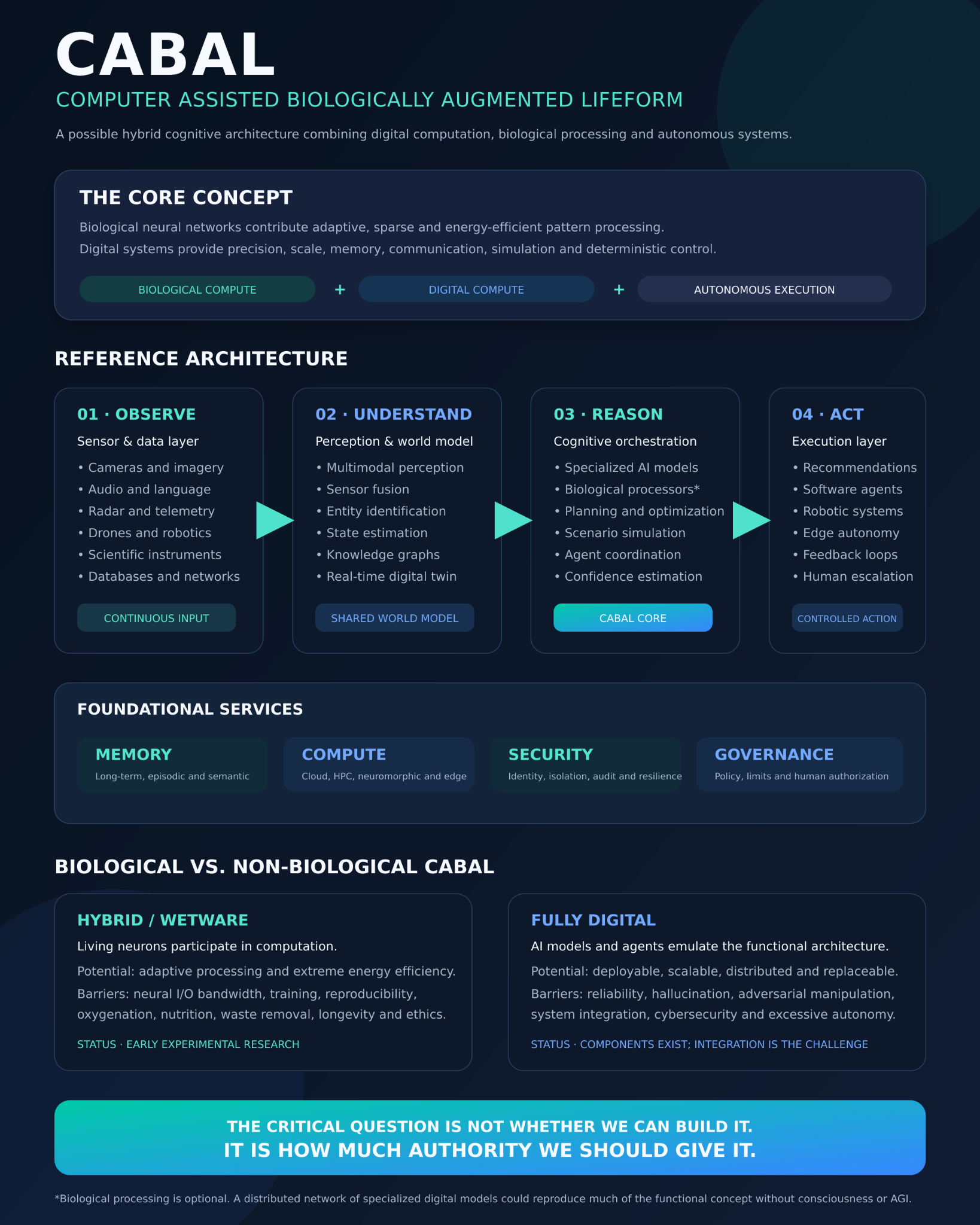
CABAL stands for Computer Assisted Biologically Augmented Lifeform. At its most ambitious, it describes a cognitive system in which conventional computers and living neural tissue work together, each contributing the abilities for which it is naturally suited.
Silicon processors are precise, fast and repeatable. They can store enormous quantities of information, perform exact calculations, communicate across global networks and execute instructions reliably. Biological neural networks work differently. They are massively parallel, adaptive, tolerant of noise and remarkably energy-efficient. A hybrid system would not simply replace a CPU with a cluster of neurons. It would combine two very different kinds of computation into a single operational architecture.
Why biological computation is being taken seriously
The idea sounds futuristic, yet several of its foundations already exist in laboratories. Researchers can grow neural organoids from human stem cells, maintain cultured neurons on microelectrode arrays and exchange electrical signals with them. Experiments have shown that networks of living neurons can respond to feedback from simple digital environments and modify their activity over time.
This field is often described as biocomputing, wetware computing or organoid intelligence. The terminology varies, but the underlying proposition is the same: living neural tissue may be usable as a computational substrate.
Neuromorphic computing approaches the same problem from another direction. Instead of using biological neurons, neuromorphic chips imitate some of their event-driven behaviour in silicon. They process information through networks of artificial neurons and synapses, often activating only when an event occurs. This can make perception and pattern-recognition workloads far more energy-efficient than continuously operating conventional architectures.
What a biological CABAL would require
A functioning biological CABAL would be much more than a dish of neurons connected to a computer. It would need a complete life-support, communication and control system around the biological component.
1. A high-bandwidth neural interface
Microelectrode arrays can stimulate neurons and record electrical activity, but their bandwidth and resolution remain limited. A useful hybrid processor would need to communicate with a large neural network at many points simultaneously, without damaging the tissue or losing signal quality over time.
2. A way to train biological networks
Software is programmed through formal instructions. Neural tissue learns through stimulation, reinforcement and adaptation. We would need reliable methods for turning a desired computational task into signals that a living network can learn, and for interpreting its changing output. The resulting behaviour would have to remain stable enough to be useful.
3. Continuous biological support
Living tissue requires oxygen, nutrients, temperature control and waste removal. Larger organoids also need vascular-like systems because diffusion alone cannot support cells deep inside the tissue. A biological processor would therefore resemble a miniature life-support system as much as a computer component.
4. Reproducibility and fault tolerance
Two manufactured processors of the same model behave almost identically. Two biological neural cultures do not. Each develops differently and continues to change. A practical system would have to calibrate itself, compensate for biological variation, recover from cell loss and preserve important learned functions even as its substrate evolves.
5. Ethical and legal governance
As neural systems become more complex, questions of welfare, consent, ownership and moral status become unavoidable. At what level of organization could neural tissue experience something analogous to sensation? Who is responsible for its treatment? Can a biological system be owned as equipment? These questions must be addressed before capability outruns governance.
The biological component may be optional
The name CABAL suggests a biologically augmented system, but the functional concept does not necessarily depend on living tissue. A fully digital CABAL could emerge sooner by coordinating technologies that already exist.
Consider a distributed system with continuous access to satellites, cameras, radar, drones, scientific instruments and connected sensors. Multimodal AI models interpret imagery, speech, video, telemetry and text. A shared world model represents entities, events, locations and uncertainty. Planning engines run simulations, compare possible actions and optimize decisions. Software agents and robotic systems then execute approved tasks, observe the results and feed them back into the model.
Observe
Collect continuous signals from sensors, networks, databases and human communication.
Understand
Fuse inputs into a persistent, real-time model of the environment and its changing state.
Reason
Coordinate specialist models, planning engines, simulations and autonomous agents.
Act
Issue recommendations or controlled actions through software, robots and edge systems.
No single model would need to possess every ability. A language model might interpret intent and coordinate tasks. Vision models would understand imagery. Optimization systems would allocate resources and plan routes. Knowledge graphs and vector databases would provide persistent memory. Digital twins would simulate possible futures. Specialist agents would operate tools, while a supervisory layer would manage priorities, confidence, permissions and escalation.
A system, not a single intelligence
We often imagine advanced intelligence as one enormous mind. A practical CABAL would more likely be a federation of specialized components that behaves coherently because they share context, memory and objectives.
This distinction matters. Such a system would not require consciousness, emotions or even true Artificial General Intelligence. It could appear broadly intelligent because it combines perception, memory, reasoning, planning and action across many domains. Its capability would come from architecture and integration rather than from a single all-purpose model.
The closest analogy is not one brain but an organization operating at machine speed: many specialists, a common operational picture, institutional memory, decision processes and mechanisms for carrying decisions into the world.
The engineering challenge is integration
Most of the digital components already exist individually. What does not yet exist is a dependable way to combine them at this scale. A CABAL-like system would have to operate continuously, distinguish facts from uncertain inferences, manage contradictory data, resist manipulation and explain the basis of consequential decisions.
Its foundational services would be as important as its visible intelligence. Long-term memory must be auditable and correctable. Identity and access controls must apply to both people and autonomous agents. Cybersecurity must assume adversaries will attack sensors, models, communications and stored knowledge. Critical actions must remain within explicit technical and legal limits.
The central risk is authority
The most powerful version of CABAL would not merely analyse the world. It would be connected to the means of changing it: financial systems, communications, industrial infrastructure, drones, robots and perhaps defence platforms.
That makes the decisive design question one of authority. Should the system only advise humans? May it act autonomously within a narrow envelope? Who defines that envelope, and who can override it? How do we stop gradual expansion of its powers as operators grow accustomed to its speed and convenience?
“The critical question is not whether we can build it. It is how much authority we should give it.”
Good governance cannot be added after deployment. It must be embedded in the architecture: least-privilege access, reversible actions, independent audit, human authorization for high-impact decisions, graceful degradation and reliable shutdown mechanisms. The system should be designed to remain useful when uncertain and safe when parts of it fail.
Could CABAL become real?
A mature biological CABAL remains distant. Neural interfaces, biological maintenance, training methods and ethical frameworks are not ready for the role imagined here. Wetware computing is still early experimental research.
A non-biological CABAL is far more plausible. Its sensors, AI models, planning systems, robots, data centres, edge devices and knowledge infrastructure already exist. What remains is the difficult work of connecting them into a resilient system that can perceive, reason and act without losing human control.
The first real CABAL may therefore contain no living neurons at all. It may emerge quietly as a distributed architecture: not conscious, not a single machine and not recognizably alive, but able to observe the world continuously, maintain a working model of it and coordinate action at a scale no human organization can match.
At that point, the technical achievement will be extraordinary. The political, ethical and civilizational judgement required to govern it will be greater still.